Marie Laveau, or the Queen Made of Newspapers
2026-11-16, originally published on pablo.space.
← all Chamber of Reflections texts
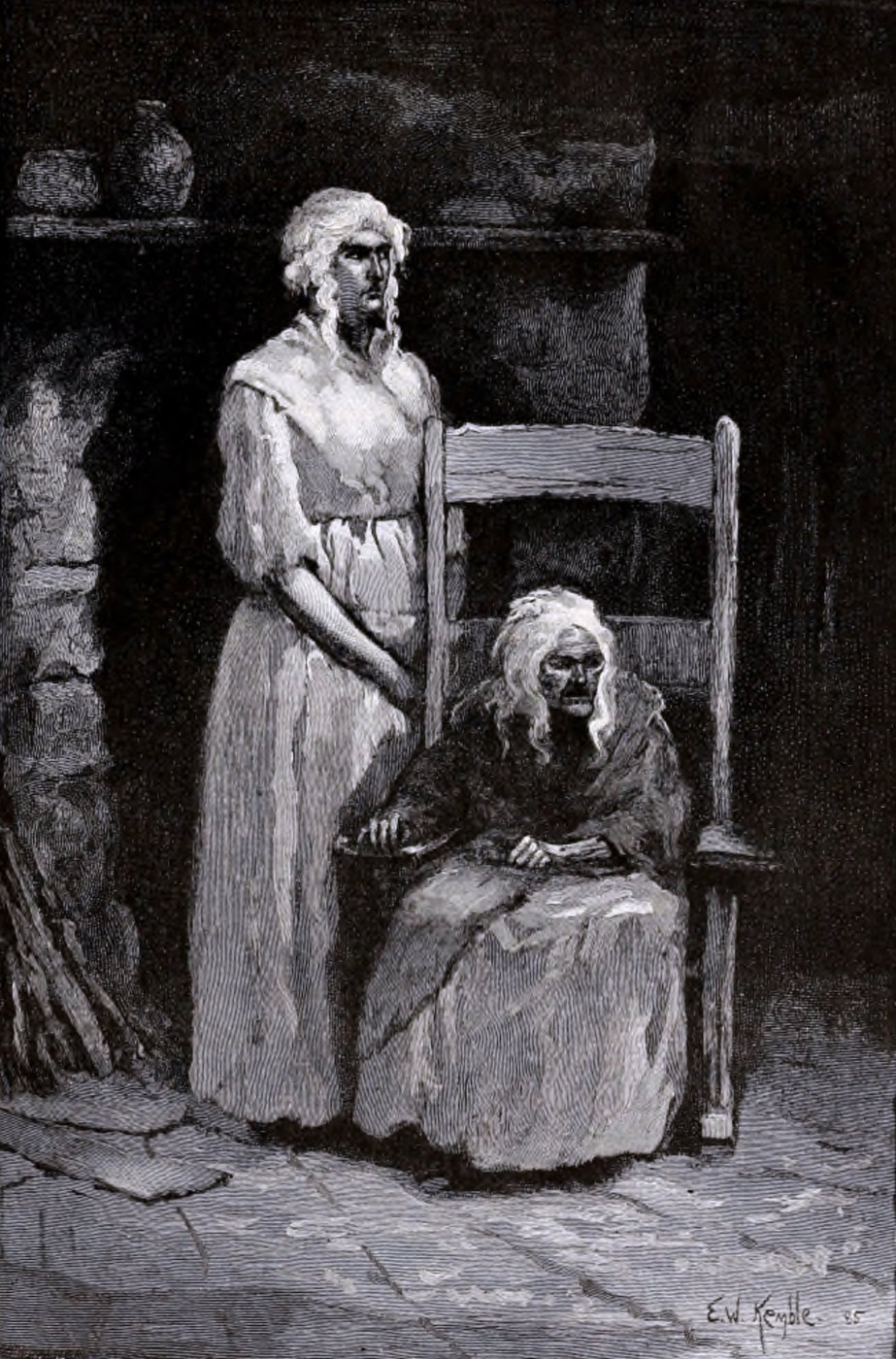
E. W. Kemble, Marie Laveau, engraving for George W. Cable’s “Creole Slave Songs”, The Century Magazine, vol. 31, April 1886, p. 819. Drawn in 1885, four years after her death, to illustrate Cable’s account of a visit to her house. Public domain, via Wikimedia Commons.
“Much evil dies with her, but should we not add, a little poetry?”
New Orleans Democrat, 17 June 1881
A Catholic who nursed the sick and prayed with the condemned, and the Voodoo Queen that newspapers, writers and tour guides built after she died.
A tomb with three crosses
In St. Louis Cemetery No. 1, a few steps from the French Quarter of New Orleans, there is a whitewashed tomb with three vaults. The marble tablet says Famille Vve Paris née Laveau: the family of the Widow Paris, born Laveau.
For decades visitors covered its walls with crosses, and then with Xs, often in groups of three, drawn in brick dust, charcoal, marker and lipstick. In December 2013 someone climbed the cemetery wall at night and painted the whole tomb pink. Since March 2015 no visitor can walk in there without a licensed guide.
The woman inside is the most famous name in the religious history of New Orleans. The popular image is the Voodoo Queen with a snake on her shoulders, dancing at Congo Square, rising out of Lake Pontchartrain on St. John’s night with candles on her head.
The parish registers show someone else: a free woman of color, baptized, married and buried by the Catholic cathedral of her city, a mother who buried most of her children, a nurse in the epidemics and a visitor of men waiting for the gallows. By every account of her own time she was also the leading priestess of the city’s Voudou congregation.
The Marie Laveau of the archives was a Creole Catholic and a Voudou priestess for her whole life. The Voodoo Queen of the legend was assembled mostly after 1881, in newspapers, magazines, folklore collections, a bestseller of 1946 and, much later, on walking tours.
I want to tell both stories here, and keep them apart. As always on this blog, I write as a historian: no rituals and no recipes, only documents, the people who wrote them, and the respect owed to a religion that its enemies spent a century describing on its behalf.
A note on words. Nineteenth-century New Orleans wrote Voudou or Vaudoux. Following the historian Carolyn Morrow Long, I use Voodoo for the religion of Louisiana and Vodou for the religion of Haiti, which are related and distinct.
The great-granddaughter of Marguerite
Marie Laveau was born in New Orleans on 10 September 1801. The date comes from her baptismal record, which the historian Ina Johanna Fandrich published in 2005 in the journal Louisiana History. For more than a century the books had given 1794, and her obituary made her ninety-eight.
Carolyn Morrow Long reconstructed the family from sacramental and notarial records. It begins with a woman called Marguerite, who had no surname because she was enslaved, and who was probably brought from Senegal to Louisiana aboard the St. Ursin in 1743. Her daughter Catherine was born enslaved, bought her freedom in 1795, took the name Catherine Henry and became a market woman with enough money to build a cottage on St. Ann Street, between Rampart and Burgundy. Catherine’s daughter, Marguerite Henry, was freed in 1790.
Marie was the first of that line to be born free.
Her father was Charles Laveaux, a free man of color who did well in real estate and in the slave trade. The obituary of 1881 turned him into “a rich planter” who had sat in the state legislature, and later writers repeated it. Long is sharp about one of them: “Robert Tallant certainly knew better, having had access to the LWP files in which Marie Laveau’s parentage is clearly documented, yet he did nothing to correct the error” (A New Orleans Voudou Priestess, 2006, p. 22).
The Widow Paris
On 4 August 1819 Marie Laveau married Jacques Paris in the St. Louis Cathedral. He was a free quadroon carpenter from Saint-Domingue, the French colony that had become Haiti in 1804. According to the 1881 obituary, Père Antoine, the city’s Capuchin pastor, celebrated the wedding, and “Mr. Mazureau the famous lawyer” signed as witness.
Baptismal registers show two daughters, Félicité and Marie Angèlie Paris. The funeral registers for those years are lost, so we only presume that both died as children.
Then Jacques Paris vanishes from the records. Long writes that he “died or disappeared around 1824”. In 2021 a student at Louisiana State University proposed that he died in Baton Rouge in 1823, a lead that has not been confirmed.
From then on the documents call her la veuve Paris, the Widow Paris. The title is on the tomb.
A white nobleman she could not marry
By 1826 Marie Laveau was living with Louis Christophe Dominic Duminy de Glapion, a white man of noble French descent. Louisiana law did not allow a white man to marry a woman of color, so they never married, and they stayed together until his death in 1855.
They had seven children between 1827 and 1838, four sons and three daughters. The records show that only two of them grew up: Marie Héloïse Euchariste Glapion, born in 1827, and Marie Philomène Glapion, born in 1836. The obituary gave her fifteen children, which became one more piece of the legend.
The family lived in the cottage on St. Ann Street, which Glapion had bought after the grandmother’s death. When he died the house was seized for his debts, and the family stayed only because a friend bought it.
The records also show something the legend leaves out. Long found that Marie Laveau bought two enslaved women and later sold them. Other writers give a higher number, which I have not been able to verify.
The hairdresser, perhaps
Every popular biography says she was a hairdresser to the white ladies of the city. In the version Robert Tallant made famous, she listened while she worked, collected the secrets of rich households, paid or healed their servants for more, and then sold the information back as clairvoyance.
The story comes from interviews collected in the 1930s by the Louisiana Writers’ Project, a New Deal program, with elderly people who remembered her or her family. Long looked for a document that would confirm or refute it and found neither.
Nothing in the story is impossible. The spy network built on gossip, though, is the kind of detail that makes a good chapter, and it reached print through a writer who liked good chapters.
Ninety-eight years in the newspaper
Marie Laveau died at home on St. Ann Street on 15 June 1881, a few months short of eighty. She was buried the next afternoon. The burial book of the archdiocese, which Long consulted, records that “Dame Christophe Glapion” was placed in the family tomb of the Widow Paris, middle vault, on 16 June 1881, at the request of her daughter Philomène.
On 17 June the Daily Picayune printed a long obituary under the headline “Death of Marie Laveau”. It is a portrait of a saint. She was born, it says, “ninety-eight years ago”; she nursed the sick through the yellow fever of 1853 at the request of a committee of citizens; she sat with condemned prisoners; Lafayette came to her house and kissed her on the forehead. And at the funeral:
“Her remains were followed to the grave by a large concourse of people, the most prominent and the most humble joining in paying their last respects to the dead.”
As transcribed, the obituary never uses the word Voudou.
The New Orleans Democrat of the same day wrote the line at the top of this post. The next day it asked “Who has been stuffing our contemporaries”, and described her as “the prime mover and soul of the indecent orgies of the ignoble Voudous”. On 23 June the New York Times followed with “The Dead Voudou Queen”.
In one week the city’s press produced two Marie Laveaus, a Catholic nurse and a queen of orgies, both written by people who had never been inside her religion.
The Common behind the city
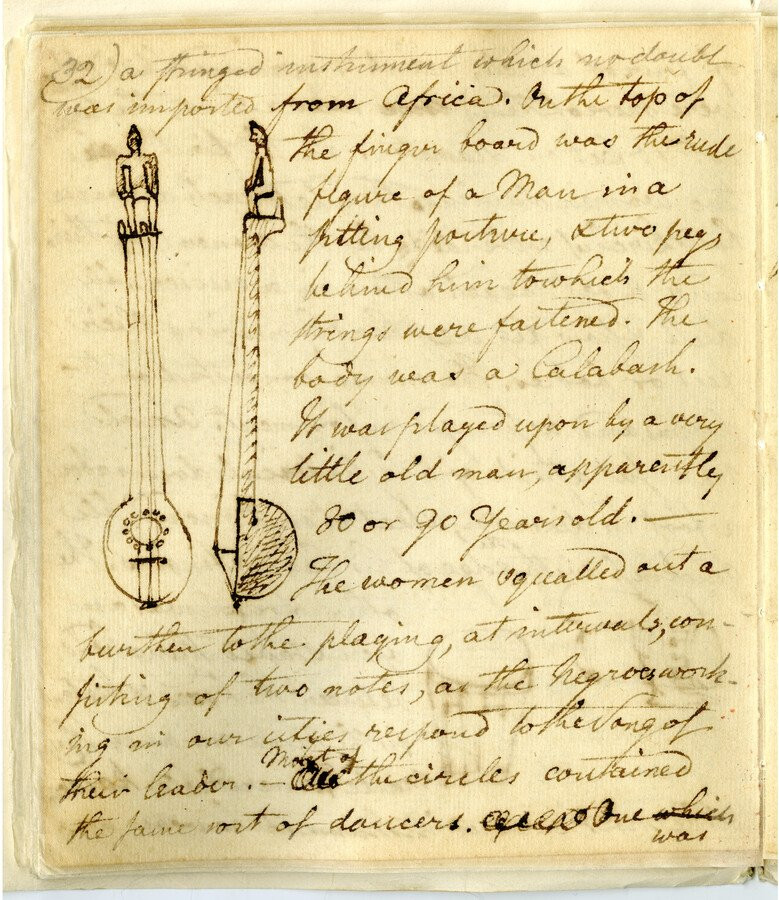
Benjamin Henry Latrobe, sketch of a string instrument played on the Common (today’s Congo Square), New Orleans, February 1819. Journal IV, p. 32, Maryland Center for History and Culture. Public domain, via Wikimedia Commons.
Behind the old city, beyond Rampart Street, there was an open field where enslaved Africans gathered on Sunday afternoons. An ordinance of 1817 confined such gatherings to that one spot. The city renamed it Beauregard Square in 1893, and the City Council restored the name Congo Square in 2011.
The best-known eyewitness is the architect Benjamin Henry Latrobe, who walked out there on a Sunday in February 1819 and found “a crowd of five or six hundred persons”. He saw circles of dancers, drums, a stringed instrument and songs in “some African language”. He found it “brutally savage”, and still wrote: “The allowed amusements of Sunday have, it seems, perpetuated here those of Africa among its former inhabitants.” And then, almost with relief: “There was not the least disorder among the crowd.”
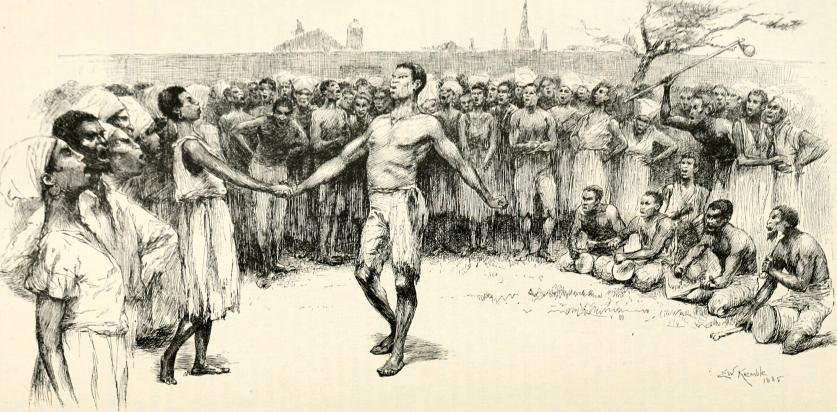
E. W. Kemble, dancing at Congo Square, illustration for George W. Cable’s “The Dance in Place Congo”, The Century Magazine, vol. 31, February 1886. Drawn decades after the Sunday gatherings had ended. Public domain, via Wikimedia Commons.
No document of her lifetime puts Marie Laveau at the head of those dances. The claim grew later, and one of the keepers of her legend denied it. In Zora Neale Hurston’s Mules and Men (1935), a man who said he had served at her altar puts it this way:
“Now, some white people say she hold hoodoo dance on Congo Square every week. But Marie Leveau never hold no hoodoo dance. That was a pleasure dance. […] Hoodoo is private.”
Nine thousand from Cuba
Thousands of people fled the revolution in Saint-Domingue after 1791, and many settled in Spanish Cuba. In 1809, after the French invasion of Spain, the Cuban authorities expelled them. In January 1810 Mayor James Mather counted about nine thousand refugees, divided in roughly equal thirds between white people, free people of color and enslaved people. They doubled the population of the city in a few months (Elizabeth Clark Neidenbach, 64 Parishes).
Long writes that these Haitians, “both slave and free, brought their magical and religious beliefs with them, reinforcing the existing New Orleans Voodoo community”. The key word there is existing. Africans from Senegambia and West-Central Africa had been arriving since the French colonial period, and the historian Jeffrey Anderson traces the religion mainly to them. Marie Laveau’s own great-grandmother probably came from Senegal.
We do not know when Jacques Paris arrived from Saint-Domingue, or whether he came in 1809. The city in which he married Marie Laveau ten years later had been remade by that wave.
Cousins, again
In my post on Haitian Vodou I left New Orleans for later, as a separate story. Here is the separation, as plainly as I can draw it.
I. Haitian Vodou is the national religion of Haiti, with its lwa, its oungan and manbo, its temples and its calendar. It is alive, and practised by millions.
II. Louisiana Voodoo was the Afro-Creole religion of New Orleans and the lower Mississippi in the eighteenth and nineteenth centuries. It had priestesses called queens, a congregation, altars, feasts and a strong Catholic layer. Historians such as Anderson consider that it faded away in the early twentieth century.
III. Hoodoo, or conjure, or rootwork, is the African American folk magic of the South: charms, roots, candles, a practitioner and a client, with no congregation behind it. Nineteenth-century New Orleans used hoodoo and voudou almost interchangeably, and the line between them is blurry in the sources. Hurston’s teachers were hoodoo doctors who claimed Marie Laveau’s name.
IV. The Spiritual churches of twentieth-century New Orleans are another tradition again.
V. The revival. From the 1970s the tourist trade opened Voodoo museums and shops, and from 1990 new temples appeared, such as Priestess Miriam Chamani’s Voodoo Spiritual Temple and Sallie Ann Glassman’s congregation, La Source Ancienne. Long describes this revival as closer to Haitian Vodou and Cuban Santería than to the religion of Marie Laveau. Its members honor her as an ancestor.
The doll full of pins sold in souvenir shops seems to owe more to European magic, the New Orleans souvenir trade and the cinema, as I wrote in the Vodou post and, for the far older European dolls, in Maleficium.
Altars in the condemned cell
Marie Laveau was baptized, married and buried by the St. Louis Cathedral. Her children were baptized there. She was godmother to a nephew and to a granddaughter, and she paid for the schooling of a seven-year-old orphan at the Catholic Institution for Indigent Orphans. A newspaper article of 1871, cited by Long, describes her setting up altars in the cells of condemned prisoners and praying with them before they went to the gallows.
She was also, for decades, the head of the Voudou community. The press rarely wrote about her while she was alive, but when it did, Long notes, it called her “the head of the Voudou women”, “her majesty”, “the Priestess of the Voudous” and “the ancient queen”.
On 12 July 1859 a neighbor complained about the noise from her house, and the Daily Crescent reported it this way:
“Marie Clarisse Laveau, f.w.c., the notorious hag who reigns over the ignorant and superstitious as the Queen of the Voudous, was complained of by her neighbor […]. Her majesty, Queen Marie, was duly sent after.”
(f.w.c. means “free woman of color”, a label the law required.)
What happened inside the house we know mostly from Writers’ Project interviews of the late 1930s. A woman named Marie Dédé, who had played with Laveau’s grandchildren as a girl, remembered: “She had all kinds of saints’ pictures and flowers on the altar. In the front room by the door she had a big St. Anthony.” Others described statues of St. Peter and “St. Marron”, and a feast for the spirits spread on a white cloth on the floor (quoted in Long, Nova Religio, 2002).
In the records, the Cathedral and the altar at home stand side by side, in the same life, for more than fifty years.
Twelve thousand people at the lake
The great public moment of the year was St. John’s Eve, the night of 23 June. Long describes the celebrations “credited” to Marie Laveau on the shore of Lake Pontchartrain as bonfires, drumming, dancing, ritual bathing and a communal feast, grafted onto the European midsummer night. No outsider left a reliable description.
In the 1870s the white press set out to see for itself. The historian Blake Touchstone read a score of those reports for an article of 1972 (Louisiana History), and what he found is close to comedy. In June 1872 a letter to the New Orleans Times told of three hundred people, a cauldron, an animal sacrifice, Marie Laveau presiding and a midnight plunge into the lake. Touchstone calls it “of questionable veracity”, and later writers built on it.
By 1874 the Pontchartrain Railroad was running extra trains out to the lake until one in the morning. In June that year the Picayune summed up the night:
“about 12,000 eminently respectable and intelligent people were hoaxed to the lake to witness the drunken gambols of ruffians and women of the worst character”
That year, the reports said, Marie Laveau was too old to attend. On 26 June 1874 the same paper declared: “This annual canard has become wearisome, and the vaporings of imaginative reporters have perpetuated the Voudou nonsense about as long as we think is necessary, or, indeed, decent.” It went on printing the story anyway, and in 1875 reprinted, word for word, a column it had already published in 1873. The New Orleans Republican accused the Democratic papers of using Voudou to make the newly freed population look unfit to govern.
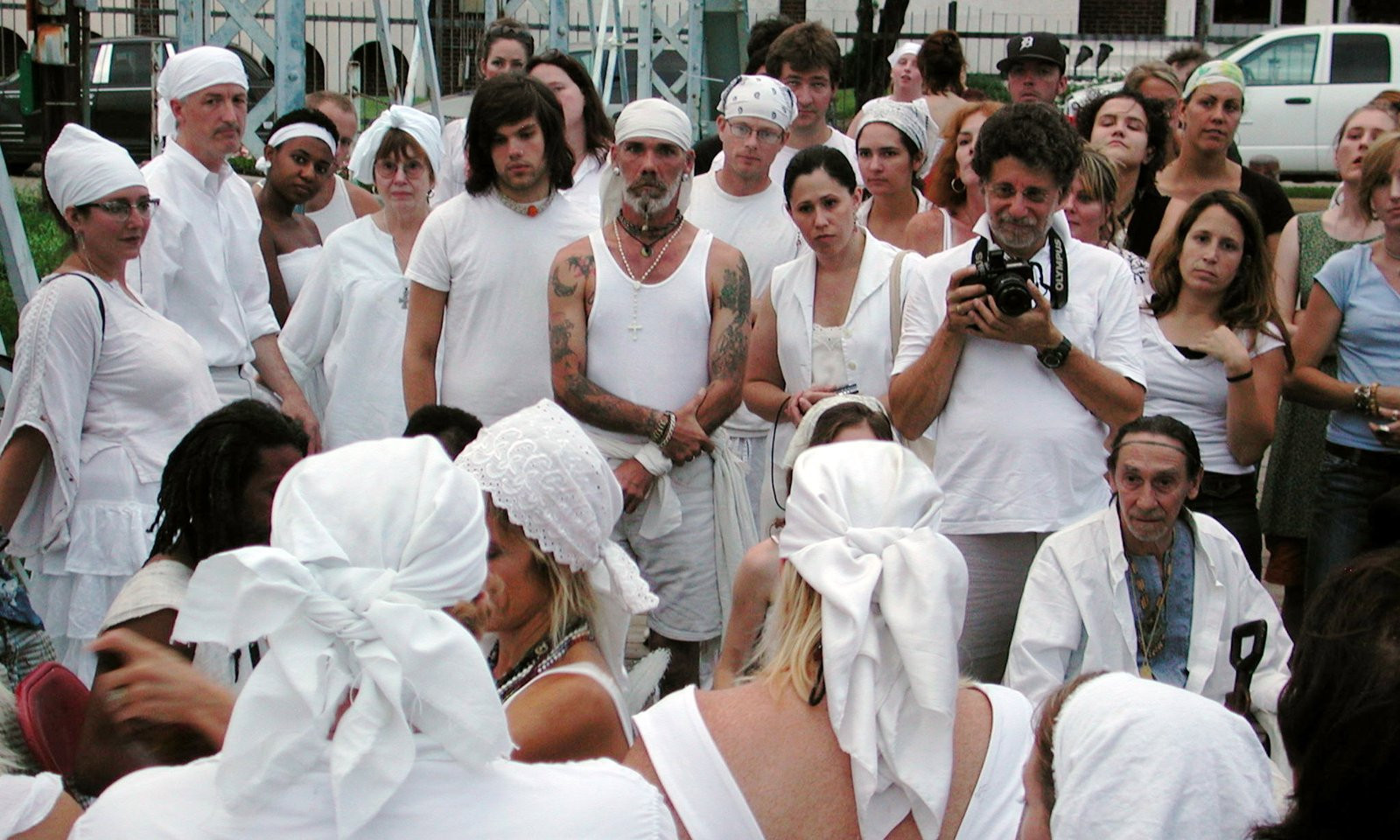
A St. John’s Eve ceremony of the modern Voodoo revival at the old swing bridge over Bayou St. John, New Orleans, 23 June 2007. Photo: Bart Everson, CC BY 2.0, via Wikimedia Commons.
The same date had another life in the city. St. John is the patron of Freemasonry, and on his day the lodges of New Orleans, black and white, held parades and picnics that the same newspapers reported without alarm.
The last of the Voudoos
The queens had male counterparts, called doctors. The best known was Jean Montanet, who died at the end of August 1885 and whom Lafcadio Hearn portrayed in Harper’s Weekly on 7 November 1885 as “The Last of the Voudoos”, alias “Jean Grisgris”, “Jean Bayou” or “Doctor John”.
According to Hearn, he was born in Senegal, claimed to be a prince’s son and pointed to the scars on his face as proof. Spanish slavers kidnapped him and sold him in Cuba, where his master freed him. He came to New Orleans as a ship’s cook and became a seer and healer. Hearn writes “I am told” more than once, and Touchstone showed that Tallant later enlarged the story.
Hearn closed his first paragraph with a sentence that also fits the woman who had died four years before: “There will never be another ‘Rose,’ another ‘Marie,’ much less another Jean Bayou.”
The researcher Barbara Trevigne found that Doctor John was buried in a wall vault in St. Roch Cemetery, in a section that has since been demolished. The “Doctor John tomb” that some guides show in St. Louis No. 1 is an invention of the 1990s. The musician Mac Rebennack borrowed the name in the 1960s.
Two Maries, or three
Marie Laveau was old for years before 1881, yet stories kept putting a queen in her prime at the lake. The legend solved this with a second Marie, a daughter who inherited name and role, in the classic form Tallant gave it in 1946. Hurston, in 1931, went further and wrote of “three Marie Leveaux”.
Long checked the daughters. Marie Héloïse, the elder, died around 1860 or 1862 (Long gives both dates), well before most of the stories set in the 1870s. Marie Philomène looked after her mother to the end, lived on St. Ann Street until her death in 1897, and was remembered as a strictly proper Catholic matron with no part in Voudou. Long’s conclusion: “The identity of ‘Marie II,’ if she existed at all, remains a mystery.”
Cable, in 1886, named a different successor: “Marie Laveau is dead; Malvina Latour is queen.” He describes Latour presiding over a ceremony on the night of 23 June 1884. Beyond Cable and the writers who copied him, little is known about her.
A visit in extreme old age
In 1886 the novelist George Washington Cable published two articles on Afro-Creole music and religion in The Century Magazine. In the second, “Creole Slave Songs”, he describes a visit:
“I once saw, in her extreme old age, the famed Marie Laveau. Her dwelling was in the quadroon quarter of New Orleans, but a step or two from Congo Square, a small adobe cabin just off the sidewalk, scarcely higher than its close board fence.”
He describes her in a rocking chair, “her body bowed, and her wild, gray witch’s tresses hanging about her shriveled, yellow neck”, and goes on: “They said she was over a hundred years old, and there was nothing to cast doubt upon the statement.” She was then a little under eighty.
Standing beside her was her daughter, whom Cable describes as “a woman of some seventy years, and a most striking and majestic figure”. Philomène, the daughter who lived with her, was born in 1836. Cable ends the scene with a sentence about how legends grow: one had only to look at the daughter “to understand how the name of Marie Laveau should have driven itself inextricably into the traditions of the town and the times” (The Century, vol. 31, April 1886, pp. 817-818).
That is the scene Kemble drew for the magazine, the picture at the top of this post.
She rose from the lake with candles
Zora Neale Hurston, who had studied anthropology with Franz Boas, went to New Orleans at the end of the 1920s to study hoodoo by apprenticing herself to its doctors. Her first report appeared as “Hoodoo in America” in the Journal of American Folk-Lore in 1931. Two of her teachers claimed to be Laveau’s grandnephews, which, Hurston wrote, “however unlikely in a physical sense, indicates that they count themselves spiritually affiliated with her ‘works.’”
In Mules and Men (1935) the teacher is called Luke Turner, “himself a hoodoo doctor, who says that he is her nephew”. Elsewhere Hurston called him Samuel Thompson, so the name is probably a pseudonym. Turner’s account of Marie Laveau begins in a register of scripture:
“Moses had seen the Burning Bush. Solomon by magic knowed all wisdom. And Marie Leveau was a woman in New Orleans.”
Then comes the legend in full: she was born in 1827 (Héloïse’s birth year), she had a rattlesnake, Queen Victoria sent her a cashmere shawl, she rose out of the lake on St. John’s Eve “with a great communion candle burning upon her head”, and she died during a storm at her house on the lake. The burial book and the obituaries record a death in bed on St. Ann Street.
The book also prints petitions attributed to Laveau’s tradition; I will leave them where they are.
Mules and Men records how hoodoo doctors of the late 1920s remembered Marie Laveau, half a century after her death, and how they made her the founder of their own work. It is first-rate evidence about them, and a late folk tradition about her.
The book everyone still reads
In the late 1930s the Louisiana Writers’ Project, part of the federal Works Progress Administration, sent workers to interview elderly New Orleanians about Voodoo and to copy every newspaper article they could find on the subject.
Robert Tallant, one of the project’s writers, drew on that material for Gumbo Ya-Ya (1945, with Lyle Saxon and Edward Dreyer) and then for Voodoo in New Orleans (1946), which is still in print and still treated by many readers as the standard source. He later wrote a novel, The Voodoo Queen (1956). Long’s judgment of the 1946 book is severe: “a racist and sensationalistic adaptation of interviews and other materials compiled by the Louisiana Writers’ Project” (Nova Religio, 2002). The “rich white planter” father, the two Maries and the hairdresser’s spy network all reached the public through him.
Modern scholarship begins with the archives. Martha Ward published Voodoo Queen: The Spirited Lives of Marie Laveau in 2004, Ina Johanna Fandrich The Mysterious Voodoo Queen, Marie Laveaux in 2005, and Carolyn Morrow Long A New Orleans Voudou Priestess: The Legend and Reality of Marie Laveau in 2006. Long’s stated aim was to separate “verifiable fact from semi-fiction and complete fabrication”.
A portrait of somebody else
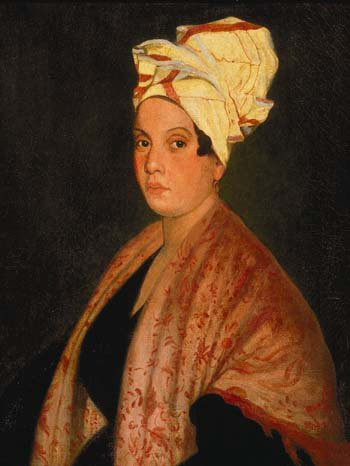
Frank Schneider, portrait of a woman formerly identified as Marie Laveau, c. 1915, after a portrait of an unidentified Creole woman of c. 1837 once attributed to George Catlin. Louisiana State Museum. Public domain, via Wikimedia Commons.
This is the face most often reproduced as hers. It is a copy made around 1915 by Frank Schneider of a portrait painted around 1837, and for decades it hung in the Louisiana State Museum as a portrait of Marie Laveau. Today it is captioned, with the museum’s credit, as a portrait of a woman “formerly identified as Marie Laveau”.
No portrait, drawing or photograph of Marie Laveau made during her lifetime is known. According to a Picayune article of 1886, her family said she had never been photographed or sketched. In 1941 the Writers’ Program guide to Louisiana joked that any old portrait of a woman of color in a tignon, the madras head wrap, was sooner or later claimed as hers.
From cross to X
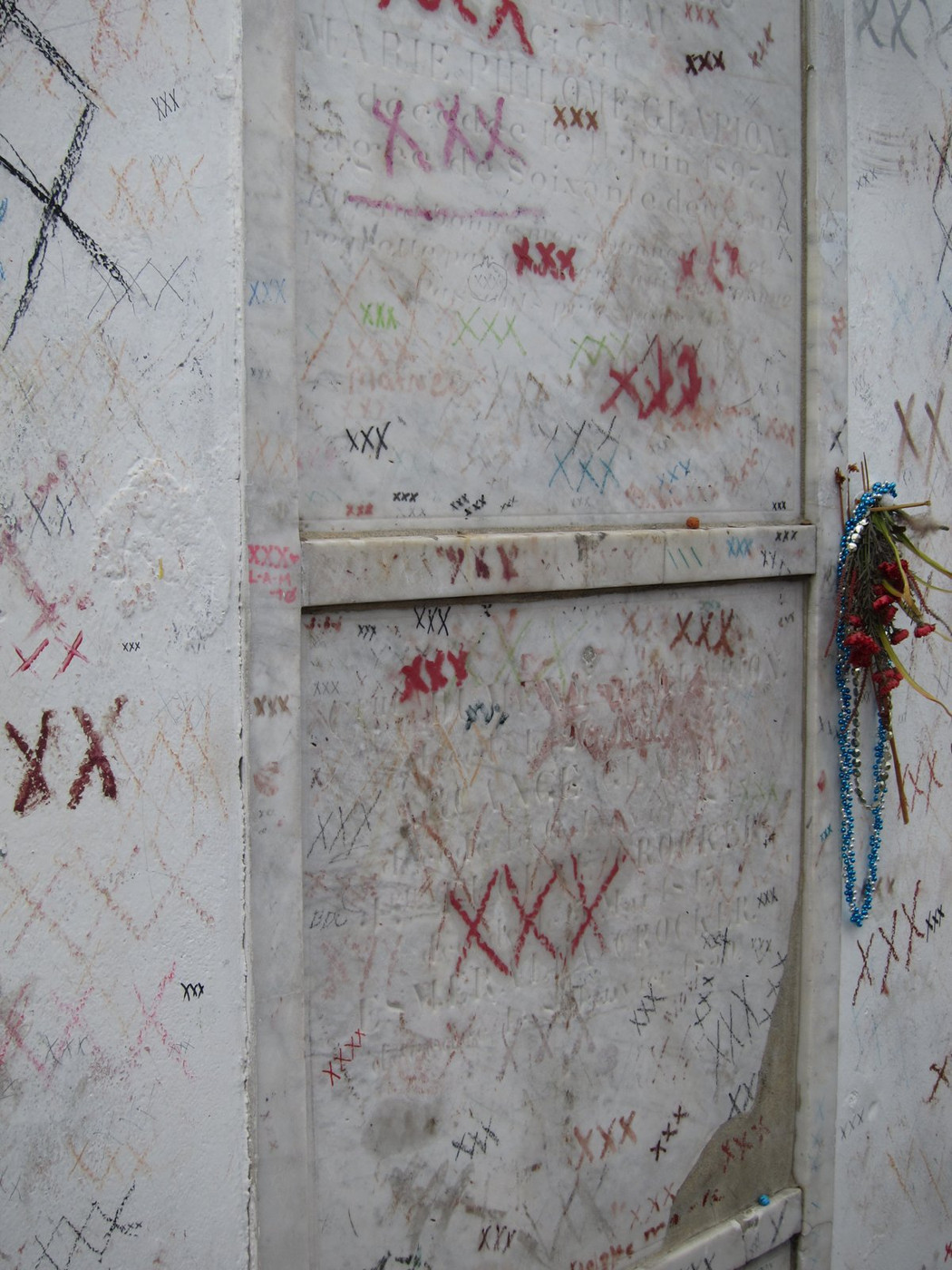
The Widow Paris tomb in St. Louis Cemetery No. 1, covered in Xs, May 2011. Photo: waitscm, CC BY 2.0, via Wikimedia Commons.
The oldest reports of devotion at her grave speak of crosses. Newspapers of the 1920s and 1930s describe offerings and cross marks, though most of them refer to a wall vault in St. Louis Cemetery No. 2 that tradition, without any record, connects with her. In 1940 the sexton of St. Louis No. 1 told a Writers’ Project worker that people came almost daily to the Widow Paris tomb and made “crosses with red brick, charcoal, and sharp rocks”, which he removed on the priests’ orders. He added that visitors knocked on the marble slab and listened at a crack (quoted in Long’s 2019 lecture for Save Our Cemeteries), a custom with relatives in another post of mine.
Long reads the cross in two registers: the cross of Christianity, and in African religious traditions the crossing point between the world of the living and the world of the spirits. In photographs of 1968 the crosses have become Xs. Some say tour guides invented the practice; Long disagrees, though she blames recent visitors, with their markers, lipstick and nail polish, for the damage to the plaster. In 2005 the city made marking a tomb illegal.
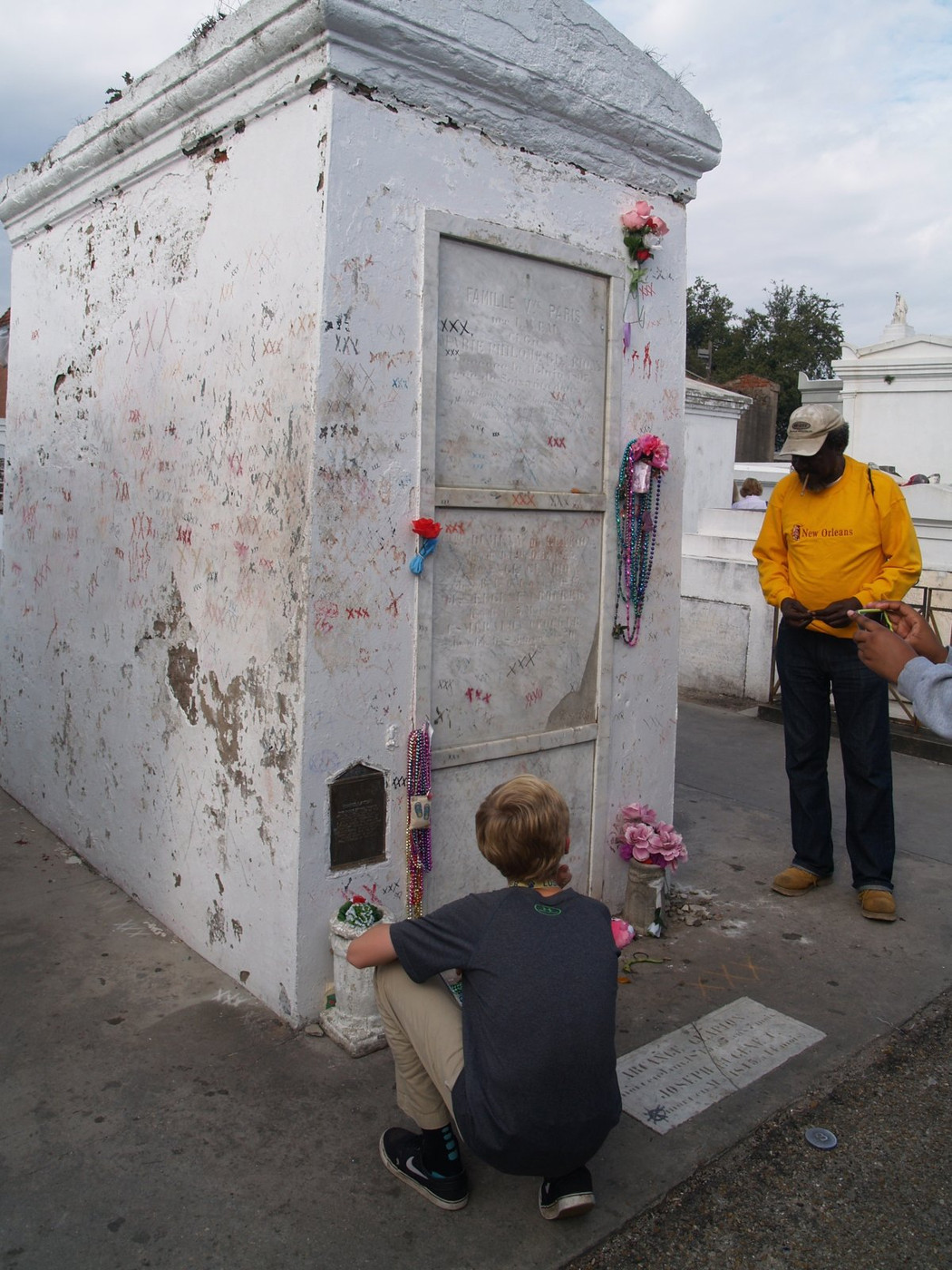
The tomb on 19 February 2014, after the pink paint had been washed off and before the restoration. Photo: Michael Homan, CC BY 2.0, via Wikimedia Commons.
In mid-December 2013 somebody painted the tomb pink with latex paint and covered the tablets in white. Nobody was ever arrested. The archdiocese, which owns the cemetery, had the paint pressure-washed off, stripping old plaster with it, over the protests of the preservation group Save Our Cemeteries. The two then paid for a full restoration in 2014, finished in time for All Saints’ Day, the first of the November feasts of the dead.
Vandalism in the cemetery went on. In January 2015 the archdiocese announced that from 1 March 2015 nobody could enter St. Louis No. 1 without a licensed guide registered with its cemeteries office, except families with a pass. Tour companies pay for the right. Offerings and marks are forbidden. On 14 March 2015 Sallie Ann Glassman dedicated an International Shrine to Marie Laveau outside her shop on St. Claude Avenue, so that devotees would have somewhere to leave them.
There is one more legend to settle: that her family moved her body in secret to St. Louis No. 2. Any transfer would have been noted across the original entry in the burial book. The entry for “Dame Christophe Glapion” has no such note. According to the record, she is still in the middle vault, next to Christophe Glapion.
The documents keep a smaller and stranger story than the legend: a free woman of color who outlived most of her children and the man she could not marry, nursed the sick, prayed with the condemned, led a congregation the city never understood, and had a Catholic funeral. The Democrat wondered whether a little poetry would die with her. The poetry stayed outside the tomb, in the hands of everyone who has written about her since. The woman is in the middle vault, where the burial book of 16 June 1881 put her.
Original: https://pablo.space/posts/marie-laveau-or-the-queen-made-of-newspapers